Odd function
What is an odd function? A function f is an odd function if f(-x) = -f(x) for all x in the domain of f.
For example f(x) = x3 is an odd function
f(-2) = (-2)3 = -2 × -2 × -2 = -8 and f(2) = (2)3 = 2 × 2 × 2 = 8
f(-2) = -8 = -f(2)
f(-1) = (-1)3 = -1 × -1 × -1 = -1 and f(1) = (1)3 = 1 × 1 × 1 = 1
f(-1) = -1 = -f(1)
In general, let x represent any number in the domain of f.
Then, f(-x) = (-x)3 = -x × -x × -x = -x × x2 = -x3 and f(x) = x3
f(-x) = -x3 = -f(x)
For f(2) = 8 and f(-2) = -8, the points are (2, 8) and (-2, -8)
For f(1) = 1 and f(-1) = -1, the points are (1, 1) and (-1, -1)
Notice that f(0) = 03 = 0, so there is a single point (0,0)
Now, try to graph these five points on a coordinate system.
(2, 8), (-2, -8), (1, 1), (-1, -1), and (0, 0)
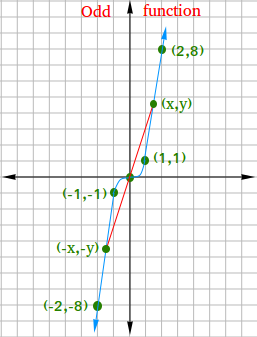
From the graph above, we can make the following two important observations:
- If a point (-x,-y) is on the graph, the point (x,y) is also on the graph.
- The function is symmetric with respect to the origin.
More examples of odd functions
- f(x) = x3 - 8x
- f(x) = x5
- f(x) = sin(x)
- f(x) = x7

f(x) = x3 + 1 is not an odd function.
f(-x) = -x3 + 1
f(-x) = -(x3 - 1)
Since x3 - 1 ≠ x3 + 1, f(-x) ≠ -f(x)
≠