Zero pair
What is a zero pair in math? A zero pair is created when you add 1 and -1 and the sum is zero.
Suppose 1 green circle represent +1 and 1 orange circle represent -1.
Then, a pair of circles made of 1 green circle and 1 orange circle is a zero pair.
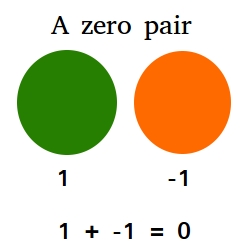
What are Zero Pairs?
If you put 5 green circles and 5 orange circles next to each other, then you have 5 zero pairs. This is the same as adding 5 and -5 to get zero.
If you put 12 green circles and 12 orange circles next to each other, then you have 12 zero pairs. This is the same as adding 12 and -12 to get zero.
If you put 500 green circles and 500 orange circles next to each other, then you have 500 zero pairs. This is the same as adding 500 and -500 to get zero.
More Zero Pair examples
Here are a few more examples of zero pairs
- {5, -5}
- {-18, 18}
- {-100, 100}
- (1200, -1200}
- {69, -69}
Notice that the absolute value of a number in a zero pair is equal to the absolute value of the other number in the zero pair.
For example, consider {5, -5} and {1200, -1200}
|5| = 5 and |-5| = 5
|1200| = 1200 and |-1200| = 1200
How Can You Use Zero Pairs to Solve Problems?
Zero pairs can help you add integers quickly in many cases.
For example, if you are adding 500 and -522, you just need to recognize that 500 and -500 are zero pairs to quickly get an answer.
500 + -522 = 500 + -500 + -22 = 0 + -22 = -22
More examples
Add -85 and 96
-85 + 96 = -85 + 85 + 11 = 0 + 11 = 11
Add 656 and -690
656 + -690 = 656 + -656 + -34 = 0 + -34 = -34