Pythagorean theorem
Definition
What is the Pythagorean Theorem? It is a theorem stating that in any right triangle, the square of the length of the hypotenuse is equal to the sum of the squares of the lengths of the legs.
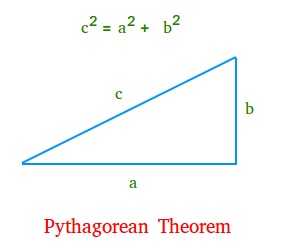
Notice that the length of the hypotenuse is c and the lengths of the legs are a and b.
Advertisement
Activity about the Pythagorean Theorem
The values a, b, and c in the table below represent the lengths of the sides of a right triangle.
| a | b | c | a2 | b2 | a2 + b2 | c2 |
| 3 | 4 | 5 | 9 | 16 | 25 | 25 |
| 6 | 8 | 10 | 36 | 64 | 100 | 100 |
| 5 | 12 | 13 | 25 | 144 | 169 | 169 |
| 1.2 | 0.9 | 1.5 | 1.44 | 0.81 | 2.25 | 2.25 |
What do you notice when you compare the values of c2 for each row to the values of a2 + b2?
You will notice as already stated that the square of the longest side is equal to the squares of the other two sides.
Check Pythagorean Theorem word problems to see how you can use the Pythagorean Theorem to solve some problems.